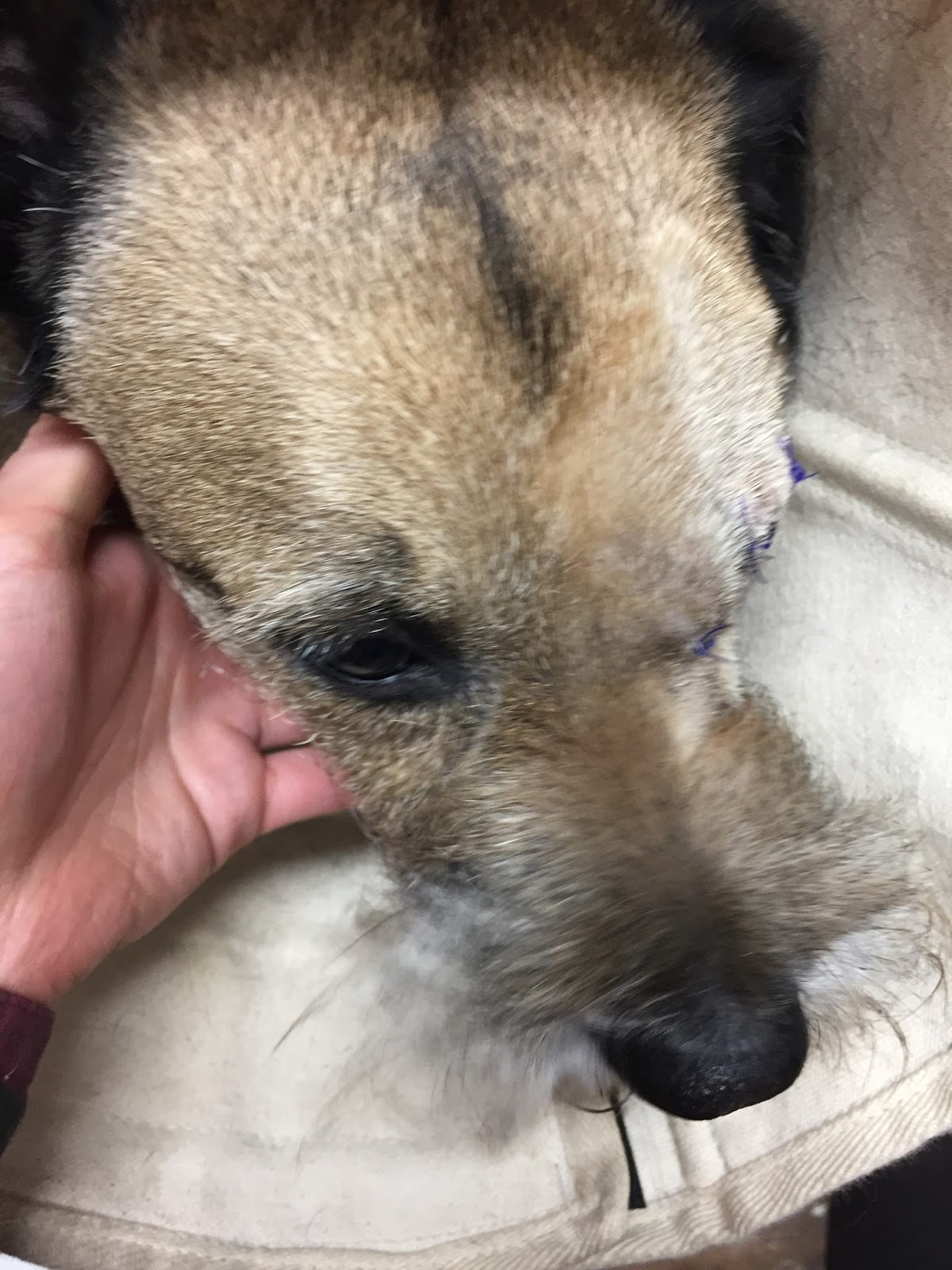
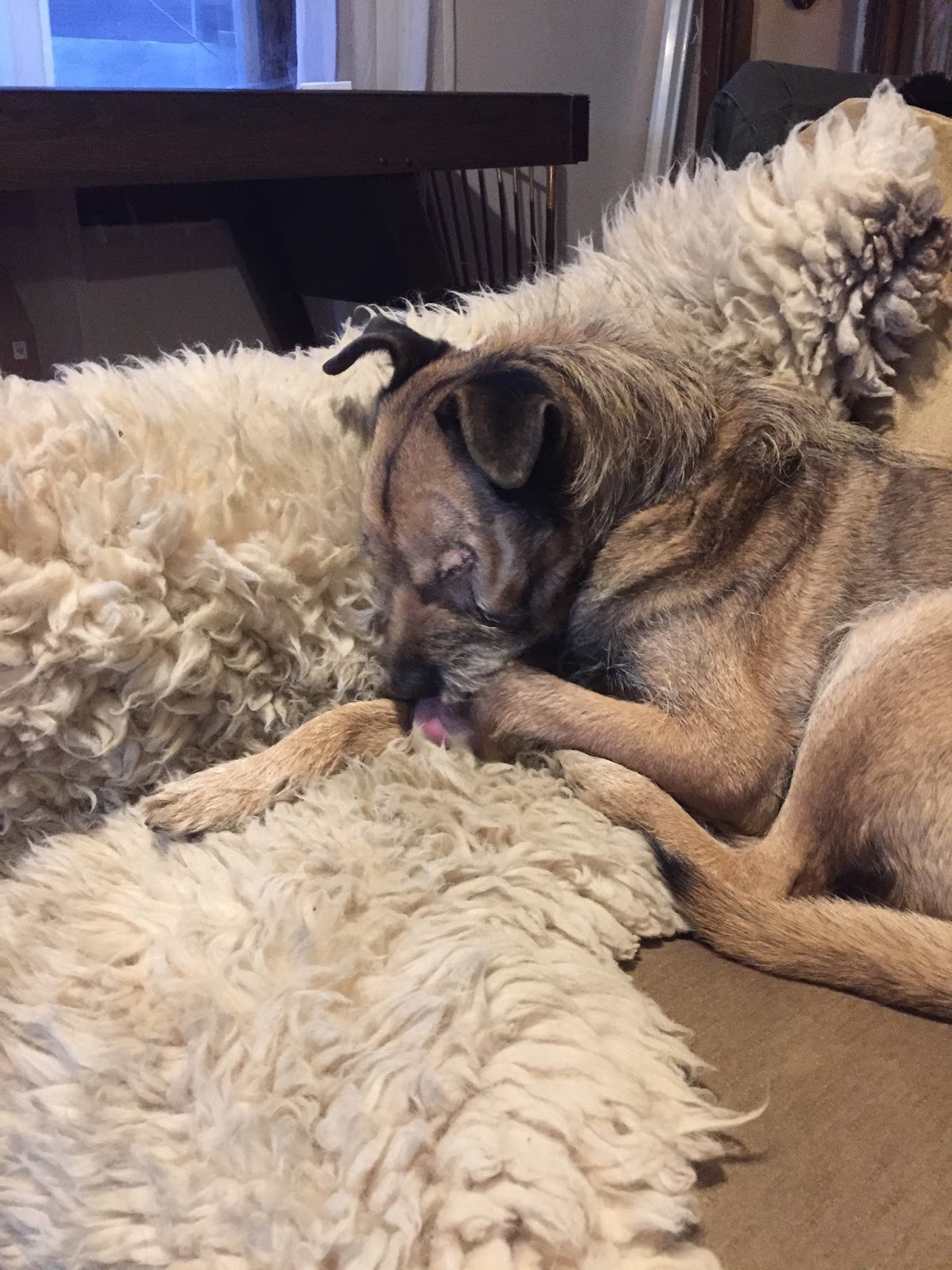
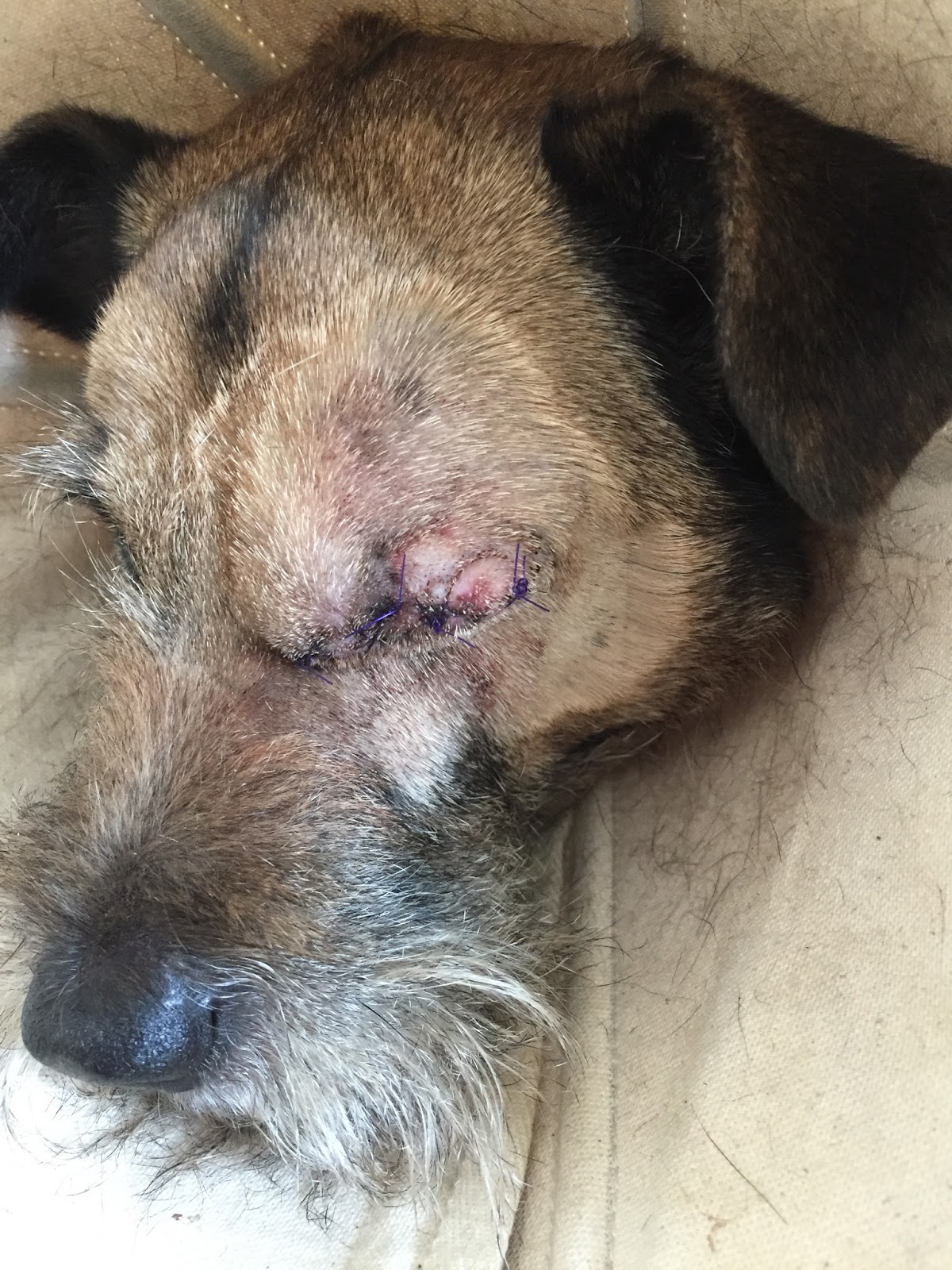
After one month, his fur is almost all the way grown back. His "scar" skin has gone from pink to black. I think he's feeling pretty good. His removed teeth stitches haven't dissolved yet and are still there. I'm still feeding him his kibble soaked in water to soften it.
Showing posts with label pet. Show all posts
Saturday, March 31, 2018
Friday, February 23, 2018
Mason's eye removal (enucleation) and teeth extraction surgery: Days 8 - 14 (two weeks) post op
Day 8:
Day 9:
Day 10:
We were supposed to be going on "short leash potty walks" according to the vet instructions, but instead we went on an overnight canoe camping trip! His eye wound started to get the caved-in look, but right around the incision site it was still coned out, so it's looking pretty weird right now.
Mason found his sacred orb in the van.
Day 11: We returned from our canoe camping trip and I forgot to take photos of his eye, but here is a photo of him between two canoes.
Day 12: Stitches got removed today so that means no more cone! There are some photos of before the stitches came out and after photos. Mason had 4 external stitches and a couple of layers of stitches under his skin. The stitches came out easily and quickly and I don't think Mason even felt it. The vet also said the stitches in his mouth are healing well (those will dissolve). She even gave him permission to eat his hard kibble again and she said I could start brushing his teeth in a week. For an hour or so after the stitches came out I could actually see the hole that the stitches left (it was very small, the exact gauge of the thread that was used) and then later in the day I noticed some reddish clear liquid in the hole, and then even later there were small scabs there. He has one scab near the center of his eye that I probably didn't notice before because a stitch was covering it.
Mason hates the vet (even more so now!) so this is my special technique to keep him calm while we are waiting at the vet.
After the stitches came out:
13 days post op:
His fur is mostly growing back but there is still a weird bald patch right above. You can also see the scab in the center.
You can see stitches where his little loose tooth was pulled on the top.
Mason's teeth after they were cleaned and six were pulled.
14 days (two weeks) post op:
Everything is pretty much same as usual. Last night he had a small amount of bleeding as if he had rubbed off a scab.
Labels:
dog,
Enucleation,
eye,
eye removal,
glaucoma,
healing,
one eyed dog,
pet,
post op,
recovery,
stitches,
surgery
Monday, February 19, 2018
Mason's eye removal (enucleation) and teeth extraction surgery: some bad news
I got the histopathology ("the microscopic examination of biological tissues to observe the appearance of diseased cells and tissues in very fine detail") results of Mason's removed eye today. The vet said it looked like he had primary glaucoma, and his ophthalmologist confirmed it. His ophthalmologist suspected he had secondary glaucoma caused by the mature cataract in that eye, so she was surprised to hear it was primary. She told me to use the left over Dorzolamide eye drops from his other eye on his one remaining eye twice a day to help delay the inevitable (my wording, not hers).
The ophthalmologist mentioned Endolaser surgery being an option in his remaining eye (...for $8,000). It has an 85% chance of saving whatever vision he has left and a 95% chance of keeping his eye pressure low. She doesn't perform it until after a spike in pressure because the other 15% is the chance that she accidentally blinds him, which is less horrible when you already know he's definitely going to go blind from glaucoma. She also said that when his pressure spikes it is very important for him to see an ophthalmologist in 1-2 hours. They could then add drops to his routine or use a needle to remove some of the fluid in the eye to relieve the pressure and hopefully save his vision.
Friday, February 16, 2018
Mason's eye removal (enucleation) and teeth extraction surgery: Let's talk money $$$
I know a lot of people don't get down right personal and talk about money, especially the exorbitant amount of money they just spent on a small animal. Well, I'm about to reveal it all: exactly what I paid, estimates from the vet, estimates from the ophthalmologist/specialist. To be clear, the year is 2018 and the location is a city: Philadelphia, PA.
Mason's eye removal surgery, teeth cleaning, and 6 teeth extraction ended up costing me $2,139.71. Ouch! Just to be clear, I expected it to be $1000 less. Not because the vet quoted me incorrectly, but because I didn't think Mason's teeth were that bad. The estimate I got from my normal vet for eye removal surgery alone was $1,507. If I were to get his teeth cleaned and 0 teeth pulled it would have been $500. If I got his eye removed and teeth cleaned at the same time it would be $1,300 if 0 teeth were pulled. Whaaaat? The teeth cleaning would basically be free and the eye removal would be $200 less? Can that be?? Yes, yes it can. It has to do with anesthesia packages.
I spent another $270 for the histopathology (dissection) of the removed eye. This will tell me if he had primary or secondary (in this case, caused by his untreated mature cataract) glaucoma. If it is primary, he will be started on glaucoma-preventing eye drops immediately. If it's secondary, we just keep a good watch on his good eye. I didn't want to spend $270 on his dead eye, but the ophthalmologist highly recommended I get this done and she wasn't making any money off that recommendation.
Before the surgery, I upgraded Mason to the most thorough blood test which was $275. My thinking behind that was that I didn't want to put an unhealthy dog under anesthesia and risk him dying, and I also didn't want to pay $2,409.71 on a surgery for an unhealthy dog.
At my vet, a regular teeth cleaning with no extractions would have cost $500. At Mason's previous vet, they quoted a teeth cleaning at $1,200! Make sure you shop around a little. It's amazing and fortunate that pet healthcare costs can be broken down so efficiently into estimates - it is not like that for people at all!
A good amount of this surgery price was the quantity of teeth he had to get pulled, and more anesthesia time. The price of extractions depends on the number of roots the teeth has, the more roots the higher the cost.
1 root - $58, 2 roots - $68, 3 roots - $104, carnassial tooth - $112
I paid so much more than I ever thought I would spend on a pet. But if Mason even lives for one more year it will all be worth it... but he better live to be 18 since it cost that much......
Here were the other estimates I received from Mason's ophthalmologist:
Intravitreal Injection: $350
This is the least expensive and least invasive choice. An injection in the eye destroys the cells that produce fluid in the eye. By decreasing the production of fluid, the intraocular pressure should remain permanently low. It's done during an office visit with local anesthetic.
I didn't choose to go this route because my ophthalmologist said that many owners who do this to a otherwise healthy dog end up having problems in the long run, but their dog will be to old/unhealthy to get it removed later. 50-90% (Ophthalmologist said 75%, vet said 50%, internet says 80-90%) who get this procedure will get phthisis bulbi (shrinking of the eye), which looks pretty nasty. Since the eye is still there, it can still become injured (it's blind, so the dog could bump it) and it could still get cancer or other diseases of the eye. In some instances more than one shot is required which really bumps the price up.
Enucleation (eye removal) with histopathology (labratory testing of removed eye: $2,300 - $2,700
This could have included a prosthesis put in the empty eye socket to "fill" it before they sewed the eyelid shut. My ophthalmologist used to do this to all her patients but since a few patients have rejected the implant years later she stopped making it standard procedure. This prevents the caved-in look.
Evisceration with Orbital Prosthesis and third eyelid flap: $2,900 - $3,500
This is when the inner eye is removed and replaced with a black ball, but the outer shell of the eye, eyelids, third eyelid, and all muscles remain intact.
I didn't go this route obviously, but I did think about it. This is the most "normal" looking option but it's also the most painful and relatively high maintenance. Many of the dogs with this procedure will require moisturizing eye drops eventually. Mason's ophthalmologist said the only reason the price is higher for the prosthesis is because the dog will need to be on intravenous pain medicine for an entire day. One of the vet techs even leaked to me that one woman who had this done to her dog was calling after a month asking if it was okay that her dog was still crying and moaning! In the end, prosthetic eyes are for you, not your pet.
Glaucoma and Cataract Laser surgery were also options, but I didn't receive an official quote since the ophthalmologist said they would be around $4,000 - $5,000. That is way out of my budget, especially for a procedure that is not 100% successful.
Management for comfort with topical drops
This is only feasible for up to two years if you are lucky. Human glaucoma drops stop being effective on dogs rather quickly.
I was paying $30 (pressure check only by vet tech) to $80 (pressure check and eye examination by ophthalmologist) every 1 to 2 weeks at the ophthalmologist. When a dog's eye pressure is high, it needs to be monitored often. If his pressure had lowered to a comfortable level and stabilized I probably could have had more time between visits.
Mason was on 3 eye drops 3 times a day.
Dorzolamide cost $25 at my local vet or $50 at the ophthalmologist for a 6.8 mL bottle that would last approximately 4-6 weeks.
Predinsone Acetate cost $120 (I got it for $60 at Costco) for 10 mL and would last about 6-8 weeks, or $80 ($40 at Costco) for 5 mL.
Latanoprost (5 mL) costs $25 at the ophthalmologist, or $60 at CVS.
I went through my receipts and I spent about $455 on ophthalmologist visits and just about $230 on prescription eye drops in two months. I also bought two bottles of Ocu-glow at $75 each. That brings my management total to $835 for around two months!
Pet (and people without insurance) prescription cost tips:
Go to Costco if you have one near you!!! You don't need a membership to get huge (50% for me) discounts on prescriptions!
Walgreens also has a prescription program where you pay a $20 yearly membership fee and can get a certain % off prescriptions. It's called Walgreens Prescription Savings Club. I don't remember exactly, but I believe if I joined the club I would've got Mason's $120 prescription for $90.
Mason's eye removal surgery, teeth cleaning, and 6 teeth extraction ended up costing me $2,139.71. Ouch! Just to be clear, I expected it to be $1000 less. Not because the vet quoted me incorrectly, but because I didn't think Mason's teeth were that bad. The estimate I got from my normal vet for eye removal surgery alone was $1,507. If I were to get his teeth cleaned and 0 teeth pulled it would have been $500. If I got his eye removed and teeth cleaned at the same time it would be $1,300 if 0 teeth were pulled. Whaaaat? The teeth cleaning would basically be free and the eye removal would be $200 less? Can that be?? Yes, yes it can. It has to do with anesthesia packages.
I spent another $270 for the histopathology (dissection) of the removed eye. This will tell me if he had primary or secondary (in this case, caused by his untreated mature cataract) glaucoma. If it is primary, he will be started on glaucoma-preventing eye drops immediately. If it's secondary, we just keep a good watch on his good eye. I didn't want to spend $270 on his dead eye, but the ophthalmologist highly recommended I get this done and she wasn't making any money off that recommendation.
Before the surgery, I upgraded Mason to the most thorough blood test which was $275. My thinking behind that was that I didn't want to put an unhealthy dog under anesthesia and risk him dying, and I also didn't want to pay $2,409.71 on a surgery for an unhealthy dog.
At my vet, a regular teeth cleaning with no extractions would have cost $500. At Mason's previous vet, they quoted a teeth cleaning at $1,200! Make sure you shop around a little. It's amazing and fortunate that pet healthcare costs can be broken down so efficiently into estimates - it is not like that for people at all!
A good amount of this surgery price was the quantity of teeth he had to get pulled, and more anesthesia time. The price of extractions depends on the number of roots the teeth has, the more roots the higher the cost.
1 root - $58, 2 roots - $68, 3 roots - $104, carnassial tooth - $112
I paid so much more than I ever thought I would spend on a pet. But if Mason even lives for one more year it will all be worth it... but he better live to be 18 since it cost that much......
Here were the other estimates I received from Mason's ophthalmologist:
Intravitreal Injection: $350
This is the least expensive and least invasive choice. An injection in the eye destroys the cells that produce fluid in the eye. By decreasing the production of fluid, the intraocular pressure should remain permanently low. It's done during an office visit with local anesthetic.
I didn't choose to go this route because my ophthalmologist said that many owners who do this to a otherwise healthy dog end up having problems in the long run, but their dog will be to old/unhealthy to get it removed later. 50-90% (Ophthalmologist said 75%, vet said 50%, internet says 80-90%) who get this procedure will get phthisis bulbi (shrinking of the eye), which looks pretty nasty. Since the eye is still there, it can still become injured (it's blind, so the dog could bump it) and it could still get cancer or other diseases of the eye. In some instances more than one shot is required which really bumps the price up.
The ophthalmologist had me do a google search of "Phthisis bulbi" and she told me which images were actually it, because many inaccurate images come up in the search.
This is a German Shepard with phthisis bulbi (shrinking of the eye)
This could have included a prosthesis put in the empty eye socket to "fill" it before they sewed the eyelid shut. My ophthalmologist used to do this to all her patients but since a few patients have rejected the implant years later she stopped making it standard procedure. This prevents the caved-in look.
Evisceration with Orbital Prosthesis and third eyelid flap: $2,900 - $3,500
This is when the inner eye is removed and replaced with a black ball, but the outer shell of the eye, eyelids, third eyelid, and all muscles remain intact.
I didn't go this route obviously, but I did think about it. This is the most "normal" looking option but it's also the most painful and relatively high maintenance. Many of the dogs with this procedure will require moisturizing eye drops eventually. Mason's ophthalmologist said the only reason the price is higher for the prosthesis is because the dog will need to be on intravenous pain medicine for an entire day. One of the vet techs even leaked to me that one woman who had this done to her dog was calling after a month asking if it was okay that her dog was still crying and moaning! In the end, prosthetic eyes are for you, not your pet.
The eye on the right is a prosthetic eye. Source
Glaucoma and Cataract Laser surgery were also options, but I didn't receive an official quote since the ophthalmologist said they would be around $4,000 - $5,000. That is way out of my budget, especially for a procedure that is not 100% successful.
Management for comfort with topical drops
This is only feasible for up to two years if you are lucky. Human glaucoma drops stop being effective on dogs rather quickly.
I was paying $30 (pressure check only by vet tech) to $80 (pressure check and eye examination by ophthalmologist) every 1 to 2 weeks at the ophthalmologist. When a dog's eye pressure is high, it needs to be monitored often. If his pressure had lowered to a comfortable level and stabilized I probably could have had more time between visits.
Mason was on 3 eye drops 3 times a day.
Dorzolamide cost $25 at my local vet or $50 at the ophthalmologist for a 6.8 mL bottle that would last approximately 4-6 weeks.
Predinsone Acetate cost $120 (I got it for $60 at Costco) for 10 mL and would last about 6-8 weeks, or $80 ($40 at Costco) for 5 mL.
Latanoprost (5 mL) costs $25 at the ophthalmologist, or $60 at CVS.
I went through my receipts and I spent about $455 on ophthalmologist visits and just about $230 on prescription eye drops in two months. I also bought two bottles of Ocu-glow at $75 each. That brings my management total to $835 for around two months!
Pet (and people without insurance) prescription cost tips:
Go to Costco if you have one near you!!! You don't need a membership to get huge (50% for me) discounts on prescriptions!
Walgreens also has a prescription program where you pay a $20 yearly membership fee and can get a certain % off prescriptions. It's called Walgreens Prescription Savings Club. I don't remember exactly, but I believe if I joined the club I would've got Mason's $120 prescription for $90.
Labels:
budget,
cleaning,
cost,
dog,
Enucleation,
estimate,
extraction,
eye removal,
fake eye,
insurance,
money,
one eyed,
pet,
prescription,
price,
procedure,
pull,
quote,
surgery,
teeth
Wednesday, February 14, 2018
Mason's eye removal (enucleation) and teeth extraction surgery: Days 5 - 7 (one week) post op
The swelling has been going down consistently every day. He's been trying to scratch and rub his eye when his cone is off. He's sneaky about it though, so I keep the cone on all the time when he's unsupervised. He's always rubbed his face/mustache on people and things to scratch it, and he's been doing that still and has been trying to do it with his eye wound.
On day six the redness in his eye was completely gone. I stopped by my boyfriend's work and Mason made the rounds and was very happy about seeing his friends. He was rocket-butting around in the field outside and had a couple good rolls in the grass. He was feeling gooood.
This photo and the next few are from his 5th day post op.
Still a little redness.
Eye wound is starting to be less "cone-ish". The swelling is going down and its getting closer to his skull.
Mason's ears stuck upright after I took off his cone.
On day six the redness in his eye was completely gone. I stopped by my boyfriend's work and Mason made the rounds and was very happy about seeing his friends. He was rocket-butting around in the field outside and had a couple good rolls in the grass. He was feeling gooood.
Mason on the 6th day.
His cone got all wet because he just drank some water.
Aww he's still just as cute.
Day 7 was pretty uneventful. He's still himself and the eye wound continues to heal a little more every day. He had his first provoked rocket-butt in the house (he only does it when provoked), which is a good sign of him not being in pain. I'm still giving him pain medication because I feel like it's better safe than sorry, but I'm starting to ween him off them now that he's one week out.
One week!
Labels:
dog,
Enucleation,
extraction,
eye,
eye removal,
healing,
health,
operation,
pet,
pulled,
recovery,
story,
surgery,
teeth
Thursday, February 8, 2018
Mason's eye removal (enucleation) and teeth extraction surgery: History
I, of course, had a freak out the night before my 8 year old
dog Mason’s surgery. I was unsure
if I was making the right decision.
It’s a lot of pressure making a big decision like that for another
being. I was put at ease after I did a couple hours of late-night Google
searching and read so many amazing recovery stories of dog eye removal,
however, I found very little about tooth removal and nothing about getting both
surgeries done at once. I wanted
to be that resource for other anxious dog moms and dads.
Mason's History:
I adopted Mason when he was 3 years old from
a rescue in Delaware, but he is originally from Taiwan. His pregnant mom was abandoned in an
apartment. The rescue took her in
and she gave birth to mason and his sister. They were in people’s homes until Mason was adopted out to a
family in Taiwan. They kept him
for 1.5 years, until they had a kid.
That’s when he was flown to the US to the sister shelter in Delaware. I think his temperament has a lot to do
with the fact that he’s never been a shelter dog. I would argue that he’s the
best dog I know, and I think many friends and anyone he’s met him for at least
5 minutes would support that claim.
He’s relatabley awkward, charms people by scratching his mustache on their legs, doesn’t beg (unless he knows you are weak), and loves getting
pets although he won’t wag his tail to show it (a clear sign of weakness). His striking good looks are only out shined by his good
behavior. He’s very low energy aka
chill, and we bring him everywhere – from local bars to friends’ parties to
weddings to art studios, and even on long canoeing and camping trips.
Mason as a puppy in Taiwan
Mason on the nose of a kayak
Mason being zip lined over a treacherous river during a camping trip
Mason on one of our many canoe and camping trips
Mason (in his altered tube with a plywood floor) and I tubing the Delaware River
Mason wearing his backpack on a hiking/camping trip with a similar sized buddy
Mason with me at work
Mason’s eye history: Mason has had a cataract in his left eye (from here on out
referred to as his “bad eye”) for at least the past couple of years. His eye looked really white and
cloudy. We’ve always figured he
didn’t have very good vision even before the cataract. He ran into a fence
once, and he loses track of his ball (excuse me, I meant sacred orb) when we
throw it often.
A stupid alley cat really threw this story off. There’s a stray cat who has a litter of
7+ kittens every season and likes to give birth to those kittens in our
neighbors alley, which is adjacent to our alley (We live in Philly – everyone
has an alley!). Mason and our
friends’ dog Banjo were of course out in the alley trying to see the cat and
kittens through the fence.
Apparently Banjo’s owner discovered a scratch on her eyebrow the next
day and thought it was probably from the momma cat. I figured Mason must have
gotten whacked too. He had a few days of squinting in his bad (left) eye. After that eye started to get better
his third eye lid would show in the evenings when he got tired on his right
eye. Another few days after that
both his eyes weren’t looking very good – constant squinting and the third eye
lid showed up in the evenings still.
I started doing hot compresses on his eyes (he had eye problems before
and the vet recommended this and it really help) for a couple of days and when
that didn’t help anything I scheduled an appointment with the vet.
Mason's eyes after the cat incident
Mason's third eyelid showing
I started going to a new vet with this appointment
(explained later) and she definitely wasn’t an ophthalmologist. She did all the eye tests and
everything was normal except he had a mature cataract (duh) and had high eye
pressure. Her pressure readings
were all over the place from 21-50 I think because she wasn't the best at taking the readings. In comparison, his other healthy eye
has consistently had the pressure of 9.
His weird eyes were not a result of the cat. They were caused by glaucoma. The vet recommended I see an ophthalmologist
in the next two weeks and she sent Mason home with a glaucoma eye drop. I found
three doggie ophthalmologists in the Philadelphia area: Upenn in Philly, VSEC
in Levittown, and Center for Animal Referral and Emergency Services (CARES) in
Langhorne all had a range of wait times for new patients from 3-12 weeks. I scheduled a far-out appointment for two
of them and told them to call me if anything opened up. CARES called back with an appointment
for Mason after a week. I was
thrilled because I had scowered the internet for info on these doctors, and the
CARES ophthalmologist had great reviews mentioning her. Dr. Martha Lowe gave
him a full exam for $135 (half the price of the other two ophthalmologists) and
I was, and still am, very impressed with her. His pressure measured 21, but he still was able to see light
and shadow in that eye. She prescribed him with two glaucoma eye drops: Cosopt (dorzolamide/timlol) and
Prednisolone acetate. On the
following visit his pressure was still high and she said he had lost the
ability to see light and shadow.
She also prescribed a third eye drop, Latanoprost, and that’s when I
noticed an improvement in Mason’s eye.
It started to look less blood shot and he started chewing rawhides
again. His pressure ended up
stabilizing in the low-mid 30s for a few visits and then it got very high
again. The ophthalmologist said
that a pressure in the 30s can be comfortable, but it’s likely the pressure
spikes and drops throughout the day, so it’s possible he’s in pain at
times. With the pressures like 50,
he definitely has a constant headache.
His eye was always bloodshot, was visibly bulging, and started to get a
blueish tint to it. The vet said
the blueness was because the pressure was so high.
Mason's bad eye with mature cataract
Mason hates the vet. Leaving the door open while we waited for the doctor helped his anxiety a lot, which helps keep his eye pressure from spiking.
Here is a list with the date and Mason’s eye pressure
measurement:
- November 22nd, 2017: 21-50. prescribed Cosopt (dorzolamide/timlol) eye drop
- November 28th: 21. prescribed 2 eye drops: Cosopt (dorzolamide/timlol) and Prednisolone acetate
- December 12th: 50. prescribed a third eye drop (Latanoprost), declared blind in bad eye
- December 28th : 33
- January 12, 2018: 67. ran of Latanoprost so he missed a few doses which explains the very high pressure
- January 19th: 50
- February 2nd: 49
- February 6th: eye removed
Mason’s mouth history:
When I adopted Mason at three years old he had already had his teeth
professionally cleaned once. I go
through periods of brushing his teeth for 2-3 months and then I’ll get out of
the habit and not brush them for a month.
His bottom teeth look very white and clean and his top back teeth
weren’t looking too hot. The ones in the way back had a lot of yellow tarter
and it was even brown in some spots.
His breath was bad, bad enough to earn him the nickname “Mr.
Stink”. I noticed his breath would
improve a lot when I would brush his teeth often. He is a slow eater.
It would take him 3-4 minutes to finish a bowl of kibble.
Mason's teeth. That small tooth next to his canine has been pretty loose for a couple of months and I knew it would have to be pulled.
Information about Glaucoma and bad teeth
There is a wealth of information about Glaucoma on the
internet and I recommend you read that.
It’s even better if you get a good vet/ophthalmologist and ask them a
ridiculous amount of questions. This is just how I understand it – in layman’s
terms as they say.
“Dr. White” checking in! (I am not any sort of doctor, this
is just a funny joke – my last name is White and I’m giving medical advice, get
it)
“DR.” WHITE’S FACTS ABOUT GLAUCOMA:
The eye is filled with clear blood that
is constantly circulating through the eye. My dog’s ophthalmologist described the eye as having a
faucet and a drain that facilitates the movement of this clear blood. When a dog has glaucoma, it’s like the
drain is filled with a bunch of rice (presumably from when you washed out the
rice pot and didn’t empty the drain catcher – c’mon I hate that!). It will still drain, but it will drain
slower than it should and the eye’s pressure will rise as a result of this slow
draining. Mason was
prescribed two eye drops at first. I don’t remember which does which but one of
them was to slow down the rate of the “faucet”, and the other was to prevent
any other “rice” from building up in the “drain”. Fun fact: I asked the ophthalmologist where it drains to and
she said it is reabsorbed by the body.
No, your dog isn’t crying tears of clear blood.
There is primary and secondary glaucoma. Primary is genetic, and secondary
is caused by something else. Primary is often caused by the dog having too
sharp of angle to their drain and is more common in specific breeds. Secondary
is often caused by diabetes, as blood sugar levels can cause the pressure to
spike so high that the dog can go blind in a number of hours. ***Glaucoma is also caused by
cataracts*** This is something I had no idea of and was never told. Signs of glaucoma are squinting, watery
eye, bloodshot eye, and bulging.
If your dog has cataracts and then you notice these signs you need to
act quickly!! If the pressure gets
high enough it will cause permanent blindness. Another fun fact: Vets refer to
the eye as the “globe”.
There is no cure for glaucoma in dogs. Human glaucoma eye drops are prescribed
but they become ineffective in a matter of months to up to two years if you are
lucky. Even glaucoma surgery
doesn’t offer a permanent solution.
“DR.” WHITE’S FACTS ABOUT BAD TEETH:
This is loosely what my vet said interpreted by my bad memory: Pockets below the gum line form when
the gum disconnects from the tooth.
Bacteria can get inside these pockets and eat away at the tooth and at
the jaw bone that holds the tooth. The result is bone loss and the tooth
becomes unstable because its roots/support system are compromised. This can cause pain that your dog just
learns to deal with. If bad teeth
are left in for a long time the bone loss will continue. This can eventually lead to the jaw
bone being broken easily because of the weak points in it!! Someone I know even has a dog that's teeth got so bad that they just cut the front half of its bottom jaw right off! And its happy as can be. The vet said the body is able to refill
the lost bone once the teeth are gone.
She also said that she knows of dogs with no teeth that are still able
to eat dry kibble! Dogs really are
amazing and resilient and that’s a fact that both certified veterinarians and
“Dr. White” can agree on!
And if you would like to read a more professional description of glaucoma and it's treatments, I recommend this website: www.animaleyecare.net/diseases/glaucoma/
Labels:
blind,
dog,
Enucleation,
eye,
glaucoma,
healing,
mutt,
one eyed,
ophthalmologist,
pet,
philadelphia,
pressure,
pulled,
recovery,
removal,
surgery,
teeth,
terrier,
vet
Location:
Philadelphia, PA, USA
Subscribe to:
Posts (Atom)